When I was working on part one of this thread, I realized that I had more to say than I could cram into one post. The passion I felt over this has faded some. I am a bit more removed at this point from the problems that stirred up so much ire in my spirit (the project isn't over, though, so I'm sure it will come up again). But even as I sit here to try to verbalize (or write) the jumbled mess of thoughts I have on this issue, the problem seems overwhelming. Or maybe it's just so simple and staring me in my face that I am just ignoring it.
I'll say this now. This post will probably be filled with sweeping, but not hasty, generalizations about the people with whom I share my field. I will also admit that I am not the most well-read librarian on library things. The number of blogs out there is overwhelming, and quite a few librarians are addressing the same issues as myself (most of them with a much broader audience than my own little blog world here). If you've read similar words somewhere else, share.
Here's how I ended part 1:
"We are Librarians, a part of a long history of subversion, controversy, rebellion, and knowledge. If knowledge is power, we have the power of entire civilizations at our finger tips. Let's use it!
Part Two will more than likely be on why most librarians won't actually step up to the plate and why I hope that I will be proven wrong."
I feel like I should clarify a little. Plenty of librarians are stepping up to the plate and fighting to show the value of our profession. Take for example the advocates in the Florida Library Association who successfully lobbied to maintain library funding for this extremely tight budget year (check out their thank you video here. Your mother was right: always say thank you). But here's the problem with some of our advocacy efforts: we often only talk to each other. We vent on listservs hidden away from the public eye. We post blogs that only other librarians are reading. We are tongue tied with our professional jargon. We only step up when there is trouble. Ok, so that's more than one problem, but I think they have a similar root: the kind of people attracted to the librarian field.
WARNING: generalization ahead
If you haven't noticed, many librarians are of a certain type. Public services librarians (front lines people, the public face of libraries) like to help people and diffuse situations, and technical services librarians (the people hiding behind closed doors or on the fifth floors of towers closed to the public) generally prefer technology to people and really don't like trouble. The appeal of the library is the illusion that each day will be filled with helping connect library users with the perfect resources. It's a blissful illusion since anyone who has worked in a library for more than an hour knows just how volatile the atmosphere in a library can be. So, we vent to each other about that. We deal with the day to day issues that invariably arise in our work place. We become so wrapped up with just getting through today that we avoid the big picture. Some one else can deal with that. I'm just too busy. We all stay in our own little words talking to the people we know agree with us and just treading water. I know I'm guilty.
According to the most recent (2008) O*NET numbers, there are 160,000 librarians in the US (the number is probably more since this is specifically people who identify themselves as "librarians" and the profession is much broader than that). Can you imagine if we all actually spoke with the same voice about our value to the rest of the country? But we divide ourselves. Are you aware of how many professional organizations exist for librarians? American Library Association, Special Libraries Association, Music librarians Association, Association of American Law Librarians, Medical Library Association. Check out this rather lengthy list. You would think we would all be working together, but no. We divide ourselves, claiming that no other "type" can possibly understand the problems I have in MY library or information center or whatever you call it.
I feel like this post is getting away from me. And maybe that's another problem with librarians.
If we, those of us who spent all that money getting our professional degrees, are not going to step forward and explain to the rest of the world that our value goes far beyond helping people find the next big bestseller (a valuable skill, but not our only skill), who in the world to we expect to do this for us? Are all those computer programmers out there expecting all of their users to tell the world how valuable they are? No. Do the lawyers rely on others to defend their value to the world? No. How about the doctors, plumbers, electricians, police officers... Get the picture? We are each responsible for making sure that others understand our value.
We should be adapting to the future. The world is changing and all that. But we shouldn't be allowing other people to tell us how we are supposed to change. It's like a doctor telling a plumber how to clear a drain because the doctor unclogged an artery or vice versa. They are both experts in their own field and perhaps they can learn from each other, but one can't tell the other what to do. Yes, evaluate what you're doing and why. Recognize that you may need to change. But don't just change for change's sake. And don't just stay the same because that's how we've always done it. Become active in other information professions, using the knowledge that you have already learned to help teach others. We cannot be passive any more. We cannot allow other to say that we have no value because computers are just so smart these days (computers aren't creating themselves... yet). Shock and amaze people by your mad searching, organizing, teaching, archiving, programming, writing, helping, creating, collaborating, managing, budgeting (anything else?) skills. And when they look at you weird or actually say, "Gee, how'd you know that?" just reply, "Because I am a (dudududaaaa) LIBRARIAN!" (insert image of cape bedecked person with a book on chest, wind blowing, music playing).
Don't sell yourself (and your profession) short: You are a librarian, and we all rock this world.
Thursday, June 9, 2011


Sunday, June 5, 2011
Feather weight
So this post isn't about libraries or crafting. And I do promise that What's up with libraries? Part 2 is coming soon (writing down what are usually just inaudible groans and sighs of frustration is harder than I thought). I was just reading this article and thought of an interesting connection.
So the article in question was just posted on Yahoo Shine (I'm not ashamed to say that most of my news comes from the Yahoo news feed): High fashion or bait? Fly ties now hair extensions. Go read it. I'll be here when you get back.
Done? I'm willing to do a brief summary. Basically, fly fishers are mad because the new hair trend for women is tying hard to find chicken feathers in their hair, diminishing the supply and driving up the prices. Bizarre, right? Honestly, chicken feathers? Ok, I admit, they are actually feathers from a specialized breed of roosters raised just for their feathers. From the article:
"The feathers are not easy to come by in the first place.
They come from roosters that are genetically bred and raised for their plumage. In most cases, the birds do not survive the plucking."
That's right. They at least euthanize the birds, but still. I'm really not a hard core animal rights activist, but it does seem bizarre to me that this is a trend coming out of an industry (Hollywood) that tends to really value their animals. When these feathers were only used by fly fishers, the demands really wasn't that great, but now the suppliers can't even keep up with the demand.
And they are really giving Steven Tyler the credit for this trend? Last time I checked the Native Americans have been using feathers as hair adornment for a number of years. Although, I don't think that they just tossed the carcass of the birds after they plucked the pretty feathers.
So the interesting connection that I saw in this is to a crusade that Edward Bok, long time former editor of Ladies Home Journal and benefactor of Bok Tower Gardens, took on during his explorations into ladies' fashion. Just as some background, as part of my new job, I read Bok's autobiography The Americanization of Edward Bok: The autobiography of a Dutch boy fifty years later. It's an interesting read, although the particular section I want you to read shows some of his chauvinistic tendencies (ironic, right, as the editor of a ladies' magazine?).
So, go read this section on his campaign against the use of aigrettes (the head plums of an egret) in fashion: pages 332 through 339. It's disturbing. In his research, he found that the birds were basically tortured and killed, leaving their babies to die, in order to get these feathers for the hats. Bok was outraged and picked up a personal campaign to try to get the collection of the feathers outlawed. He published articles, graphic pictures and descriptions, petitioned leaders and advocates. And you know what happened (at first at least)? Sales of the feathers increased. So after they were informed of the atrocities, women were even more eager to get this fashion accessory. Eventually, Bok was able to encourage legislation that curtailed the use of these feathers.
Has humanity really seen no progress that we still use these frivolous fobs for fashion? It's not like we're using animal skins for warmth because we have no other way to stay warm. And do we really need to use feathers from a rooster that had to die in order to decorate our hair? Where is the respect for the creatures of this earth? We are a society of so much waste, and this is just another example of how disconnected we have become from the land and creatures that live with us on this planet. What a shame.
So the article in question was just posted on Yahoo Shine (I'm not ashamed to say that most of my news comes from the Yahoo news feed): High fashion or bait? Fly ties now hair extensions. Go read it. I'll be here when you get back.
Done? I'm willing to do a brief summary. Basically, fly fishers are mad because the new hair trend for women is tying hard to find chicken feathers in their hair, diminishing the supply and driving up the prices. Bizarre, right? Honestly, chicken feathers? Ok, I admit, they are actually feathers from a specialized breed of roosters raised just for their feathers. From the article:
"The feathers are not easy to come by in the first place.
They come from roosters that are genetically bred and raised for their plumage. In most cases, the birds do not survive the plucking."
That's right. They at least euthanize the birds, but still. I'm really not a hard core animal rights activist, but it does seem bizarre to me that this is a trend coming out of an industry (Hollywood) that tends to really value their animals. When these feathers were only used by fly fishers, the demands really wasn't that great, but now the suppliers can't even keep up with the demand.
And they are really giving Steven Tyler the credit for this trend? Last time I checked the Native Americans have been using feathers as hair adornment for a number of years. Although, I don't think that they just tossed the carcass of the birds after they plucked the pretty feathers.
So the interesting connection that I saw in this is to a crusade that Edward Bok, long time former editor of Ladies Home Journal and benefactor of Bok Tower Gardens, took on during his explorations into ladies' fashion. Just as some background, as part of my new job, I read Bok's autobiography The Americanization of Edward Bok: The autobiography of a Dutch boy fifty years later. It's an interesting read, although the particular section I want you to read shows some of his chauvinistic tendencies (ironic, right, as the editor of a ladies' magazine?).
So, go read this section on his campaign against the use of aigrettes (the head plums of an egret) in fashion: pages 332 through 339. It's disturbing. In his research, he found that the birds were basically tortured and killed, leaving their babies to die, in order to get these feathers for the hats. Bok was outraged and picked up a personal campaign to try to get the collection of the feathers outlawed. He published articles, graphic pictures and descriptions, petitioned leaders and advocates. And you know what happened (at first at least)? Sales of the feathers increased. So after they were informed of the atrocities, women were even more eager to get this fashion accessory. Eventually, Bok was able to encourage legislation that curtailed the use of these feathers.
Has humanity really seen no progress that we still use these frivolous fobs for fashion? It's not like we're using animal skins for warmth because we have no other way to stay warm. And do we really need to use feathers from a rooster that had to die in order to decorate our hair? Where is the respect for the creatures of this earth? We are a society of so much waste, and this is just another example of how disconnected we have become from the land and creatures that live with us on this planet. What a shame.
Thursday, June 2, 2011
Trying to save some money
So, I made a mistake. I friended Vera Bradley on Facebook, and I have found a new obsession with the products. The problem is that my part-time librarian salary hardly allows me to purchase any pieces. So I look at the pictures and drool. Well, the other day I was ogling over the wristlet. I thought this would be the perfect accessory for my upcoming travels to the SLA Annual Conference in June. And I think to myself, "Self, you can make this. It's just a quilted bag." Yup, just a quilted bag.
For about a week, I kept looking at the piece and thinking about how I could piece together my own version. I thought and thought and thought, and I finally developed a plan.Today Last Friday, I finally finished (this was my first sewing how-to. It took me much longer to explain than I thought).


Personally, I think it came out pretty good. The finished dimensions are about 6 x 4 x 1 1/2 inches. This was no easy task, though, so I'd like to offer some tips. If you have the money, just buy the Vera Bradley. I can appreciate the prices much more now, although I imagine their factories have a number of ways to make the process much smoother. If you don't have that much money, save some time by buying the pre-quilted fabrics at your local fabric store. I didn't like any of the prints, so not an option for me. And finally, don't try this craft if you are feeling rushed or impatient. You'll be ripping out a lot of sewing.
Here are the materials that I used:

You'll need:
-- Two coordinating fabrics. I started with a yard of each since I liked the fabrics. You would think that I would have gone to my stash (and I did consider it), but no. These fabrics caught my eye on the Red Tag clearance at JoAnn Fabric. The widest piece that you would need is about 15 in., so you can use up some scraps.
-- 1 Zipper (mine was 15 inches but I ended up trimming it a bit)
-- Light quilt batting. You'll only need about a 15 inch square
-- Some sort of clip. DH and I had a terrible time finding these. They ended up being in the jewelery section of the craft store and weren't exactly what we were looking for, but it works.
-- Coordinating thread
-- Disappearing ink/Mark-B-Gone pen or some other temporary marking tool.
-- Scissors
-- Straight pins
-- Seam ripper
-- Sewing machine (I want to give you a complete list :-) )
I started the process by making a 15 x 13 inch rectangle of quilted fabric, although if I were to do this again, I would probably make it a little bigger (15 x 15) because all the sewing shrunk the size a bit. Start with a fabric sandwich: liner fabric (right side down), batting, outside fabric (right side up). Mark lines at a 30 degree angle 3/4 inch apart in a criss-cross pattern on the right side of either fabric. I used a disappearing marker to do my lines. If you do this, make sure to work quickly. By the time I was done sewing, I could barely see the lines any more.

 On the left is the marked fabric. On the right is the finished sewing. I was trying to show that I used a contrasting thread on the back. I figured since I was using such a bold liner, I might as well use a bold thread choice, too.
From this quilted fabric, cut two panels (7 1/4 x 5 inches with curved corners... I can post pattern pieces if anyone is interested) and one rectangle gusset (12 3/4 x 2 3/4 inches). I debated how to cut these out. Just be sure that the diamonds on your two panels go the same direction.
In addition to these piece, you'll also need the following:
2 pockets from outside fabric (7 1/4 x 6 1/2 inches with the same curved corners)
2 pockets from inside fabric (4 1/2 inches square)
1 piece for zipper from outside fabric (13 1/4 x 3 inches) cut in half lengthwise (2 pieces 1 1/2 inches wide)
1 piece for zipper from inside fabric (13 1/4 x 3 inches) cut in half lengthwise (2 pieces 1 1/2 inches wide)
1 strip for handle from inside fabric (12 x 1 1/4 inches)
1 piece for ring from inside fabric (1 1/2 inches square... I think... I didn't write that down) You may want two of these if you want to be able to clip the strap on the other side to make this into a purse.
Pockets:
Fold the two large pocket pieces in half, wrong sides together, to make a piece 7 1/4 x 3 1/4 inches and press. Set aside.
Fold the two small pocket pieces in half, right sides together, and sew 1/4 inch seam on two short sides, leaving the bottom open. Clip the corners, and turn the pieces right side out.
Center the two small pockets on each larger piece. Sew the smaller pockets onto the larger pockets as close to the edge as possible. Set aside.


I have to admit, just writing all this is making me tired.
Zipper
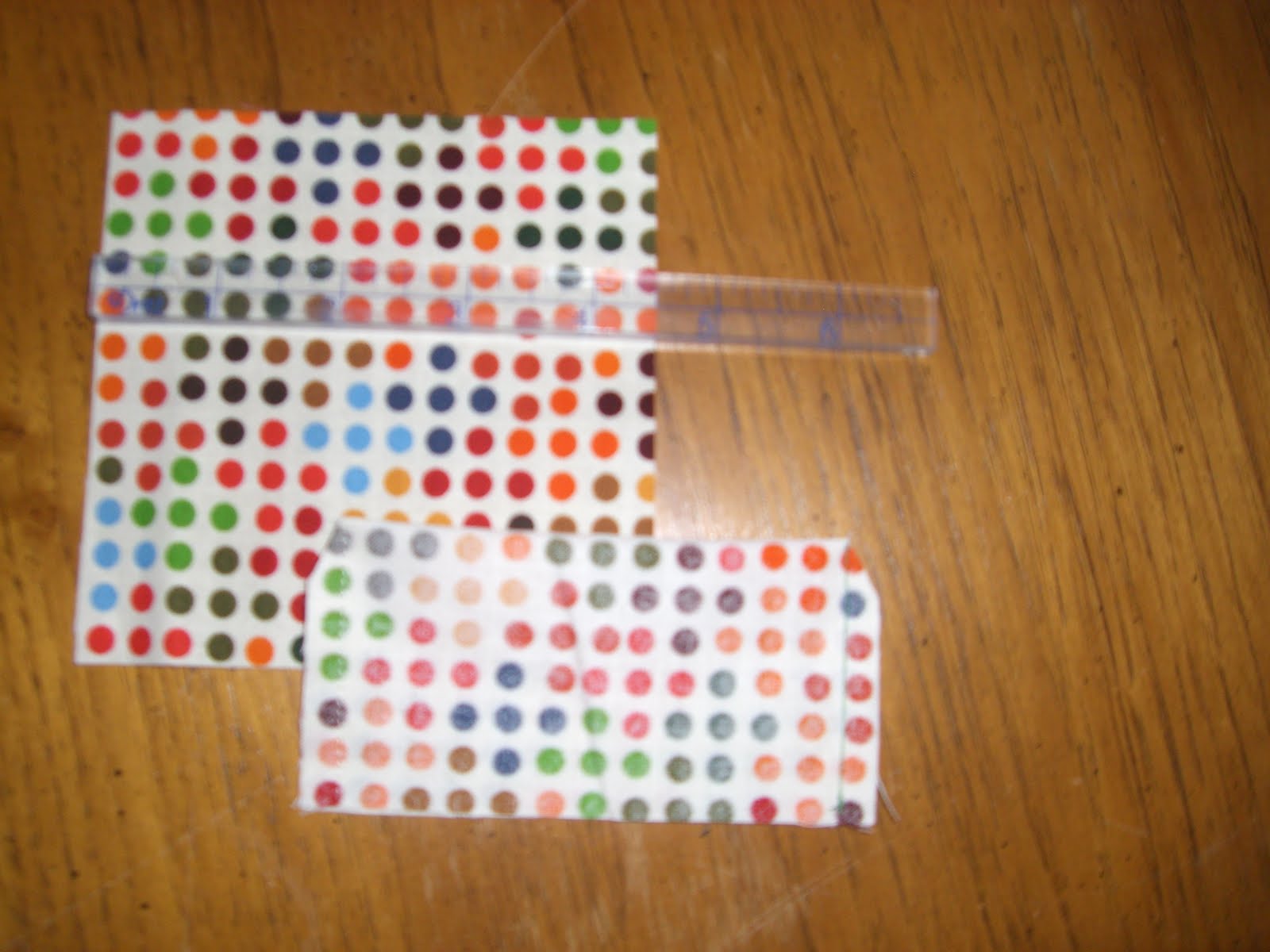
 There may be a better way to do this, but I did it this way. Press 1/4 inch along one long edge of all four zipper pieces (2 outside, 2 inside). Using your zipper foot for your machine, sew as close to the edge and zipper as possible. As you can see, the zipper is longer than my pieces. Judge for yourself how you want to line the edges of the pieces. I also folded up the short edge of one edge to form a clean edge. I suppose I could have done this on both ends, but I had already started and was being lazy.
 Strap
Strap
For this, I pressed 1/4 inch on the long sides to the wrong side of the fabric. After that I folded the piece in half long side, right side out, and pressed. Stitch along the long edge as close to the opening as possible. Attach the clip to one end. To make the fabric ring holder, sew the 1 1/2 inch square fabric, right sides together with a 1/4 inch seam. Turn right side out and press.
 Quilted guesset
This was a tricky one. Since this piece is cut from the quilted piece of fabric, I had to remove some of the quilted stitches with the seam riper. I removed enough to have about 1/2 inch of fabric unsewn. I then cut the 1/2 inch of exposed quilt batting from the piece. Fold and press a 1/4 inch of both fabrics to the inside. Top stitch across so that the edge is finished. On one side, insert the strap and the piece inserting the fabric ring.
Bag construction
Sigh. I hate pinning, but there was just no way around this one. With curved edges and gussets, pinning was a necessity. I also chose to do French Seams again, so yeah. What was I thinking. This part of the project was what made meappreciate understand the VB price tags (they are still expensive).
 Place the pocket piece you set aside on the inside of the first purse panel, matching the curved edges (the open bag picture back at the top could help you visualize this). Start by pinning the zipper gusset wrong sides together with the first purse panel. I marked the middle of the purse piece, found the middle of the gusset, and started pinning from there. I chose to open the zipper so the fabric wasn't quite so bulky. If you need to trim your zipper, now is the time. I trimmed mine and sewed over to create a new zipper stop.
Repeat the process with the quilted gusset, making sure to pin through the purse panel and the pocket. Try to make sure that the edges of the gussets are parallel to each other so your purse isn't crooked. The quilted gusset will overlap the zipper. Sew all the way around with a 1/4 inch seam. After sewing around, trim close to the seam without cutting the stitches.
Start the process again, matching right sides together now to make the pretty French Seam. Pin carefully and sew 1/4 inch seam.
Repeating this process to attach the other side of the purse can be a little complicated since the gussets won't be as flexible. In fact, I have another sewing project on my sewing cabinet that is stopped at this very point. Make sure you do zip the zipper, though, so that the zipper will match once sewn. Leave the zipper open just a little for turning. Start by matching wrong sides together (I got myself confused and had pinned the whole thing when I realized I did it wrong and had to unpin and repin the whole thing. Grr.), sew, trim, pin right sides together, sew, and TADA!
Tips on sewing. The corners will be tricky. Be careful not to have the material be too bunchy. I bunched a little too much on one side, and the gusset turned out a little crooked at the end. Did I rip it out and start over? No way. This is a homemade project. Perfection is not necessary.
I have a bit of the quilted fabric left over and have been thinking about things to do with it. I think maybe I'll make a coin purse, but I was also considering a key fob. Can't waste a good scrap of fabric, especially one that took me so long to create.
So, any brave souls out there that will try this?
For about a week, I kept looking at the piece and thinking about how I could piece together my own version. I thought and thought and thought, and I finally developed a plan.


Personally, I think it came out pretty good. The finished dimensions are about 6 x 4 x 1 1/2 inches. This was no easy task, though, so I'd like to offer some tips. If you have the money, just buy the Vera Bradley. I can appreciate the prices much more now, although I imagine their factories have a number of ways to make the process much smoother. If you don't have that much money, save some time by buying the pre-quilted fabrics at your local fabric store. I didn't like any of the prints, so not an option for me. And finally, don't try this craft if you are feeling rushed or impatient. You'll be ripping out a lot of sewing.
Here are the materials that I used:

You'll need:
-- Two coordinating fabrics. I started with a yard of each since I liked the fabrics. You would think that I would have gone to my stash (and I did consider it), but no. These fabrics caught my eye on the Red Tag clearance at JoAnn Fabric. The widest piece that you would need is about 15 in., so you can use up some scraps.
-- 1 Zipper (mine was 15 inches but I ended up trimming it a bit)
-- Light quilt batting. You'll only need about a 15 inch square
-- Some sort of clip. DH and I had a terrible time finding these. They ended up being in the jewelery section of the craft store and weren't exactly what we were looking for, but it works.
-- Coordinating thread
-- Disappearing ink/Mark-B-Gone pen or some other temporary marking tool.
-- Scissors
-- Straight pins
-- Seam ripper
-- Sewing machine (I want to give you a complete list :-) )
I started the process by making a 15 x 13 inch rectangle of quilted fabric, although if I were to do this again, I would probably make it a little bigger (15 x 15) because all the sewing shrunk the size a bit. Start with a fabric sandwich: liner fabric (right side down), batting, outside fabric (right side up). Mark lines at a 30 degree angle 3/4 inch apart in a criss-cross pattern on the right side of either fabric. I used a disappearing marker to do my lines. If you do this, make sure to work quickly. By the time I was done sewing, I could barely see the lines any more.

 On the left is the marked fabric. On the right is the finished sewing. I was trying to show that I used a contrasting thread on the back. I figured since I was using such a bold liner, I might as well use a bold thread choice, too.
From this quilted fabric, cut two panels (7 1/4 x 5 inches with curved corners... I can post pattern pieces if anyone is interested) and one rectangle gusset (12 3/4 x 2 3/4 inches). I debated how to cut these out. Just be sure that the diamonds on your two panels go the same direction.
In addition to these piece, you'll also need the following:
2 pockets from outside fabric (7 1/4 x 6 1/2 inches with the same curved corners)
2 pockets from inside fabric (4 1/2 inches square)
1 piece for zipper from outside fabric (13 1/4 x 3 inches) cut in half lengthwise (2 pieces 1 1/2 inches wide)
1 piece for zipper from inside fabric (13 1/4 x 3 inches) cut in half lengthwise (2 pieces 1 1/2 inches wide)
1 strip for handle from inside fabric (12 x 1 1/4 inches)
1 piece for ring from inside fabric (1 1/2 inches square... I think... I didn't write that down) You may want two of these if you want to be able to clip the strap on the other side to make this into a purse.
Pockets:
Fold the two large pocket pieces in half, wrong sides together, to make a piece 7 1/4 x 3 1/4 inches and press. Set aside.
Fold the two small pocket pieces in half, right sides together, and sew 1/4 inch seam on two short sides, leaving the bottom open. Clip the corners, and turn the pieces right side out.
Center the two small pockets on each larger piece. Sew the smaller pockets onto the larger pockets as close to the edge as possible. Set aside.

I have to admit, just writing all this is making me tired.
Zipper


For this, I pressed 1/4 inch on the long sides to the wrong side of the fabric. After that I folded the piece in half long side, right side out, and pressed. Stitch along the long edge as close to the opening as possible. Attach the clip to one end. To make the fabric ring holder, sew the 1 1/2 inch square fabric, right sides together with a 1/4 inch seam. Turn right side out and press.
 Quilted guesset
This was a tricky one. Since this piece is cut from the quilted piece of fabric, I had to remove some of the quilted stitches with the seam riper. I removed enough to have about 1/2 inch of fabric unsewn. I then cut the 1/2 inch of exposed quilt batting from the piece. Fold and press a 1/4 inch of both fabrics to the inside. Top stitch across so that the edge is finished. On one side, insert the strap and the piece inserting the fabric ring.
Bag construction
Sigh. I hate pinning, but there was just no way around this one. With curved edges and gussets, pinning was a necessity. I also chose to do French Seams again, so yeah. What was I thinking. This part of the project was what made me
 Place the pocket piece you set aside on the inside of the first purse panel, matching the curved edges (the open bag picture back at the top could help you visualize this). Start by pinning the zipper gusset wrong sides together with the first purse panel. I marked the middle of the purse piece, found the middle of the gusset, and started pinning from there. I chose to open the zipper so the fabric wasn't quite so bulky. If you need to trim your zipper, now is the time. I trimmed mine and sewed over to create a new zipper stop.
Repeat the process with the quilted gusset, making sure to pin through the purse panel and the pocket. Try to make sure that the edges of the gussets are parallel to each other so your purse isn't crooked. The quilted gusset will overlap the zipper. Sew all the way around with a 1/4 inch seam. After sewing around, trim close to the seam without cutting the stitches.
Start the process again, matching right sides together now to make the pretty French Seam. Pin carefully and sew 1/4 inch seam.
Repeating this process to attach the other side of the purse can be a little complicated since the gussets won't be as flexible. In fact, I have another sewing project on my sewing cabinet that is stopped at this very point. Make sure you do zip the zipper, though, so that the zipper will match once sewn. Leave the zipper open just a little for turning. Start by matching wrong sides together (I got myself confused and had pinned the whole thing when I realized I did it wrong and had to unpin and repin the whole thing. Grr.), sew, trim, pin right sides together, sew, and TADA!
Tips on sewing. The corners will be tricky. Be careful not to have the material be too bunchy. I bunched a little too much on one side, and the gusset turned out a little crooked at the end. Did I rip it out and start over? No way. This is a homemade project. Perfection is not necessary.
I have a bit of the quilted fabric left over and have been thinking about things to do with it. I think maybe I'll make a coin purse, but I was also considering a key fob. Can't waste a good scrap of fabric, especially one that took me so long to create.
So, any brave souls out there that will try this?
Friday, May 20, 2011
What is up with libraries these days? Part One
I know many of you are not librarians by trade, so you may not be aware of the shake ups happening in our little world these days. I would say it all started back when Al Gore invented the internet. There were people who said, "Wait. That's not true. I need to go to my local library and ask one of those librarians for the real story." And then there were those people who said, "Wait. What's the internet? I need to go to my library and see if I can check that out with my library card." It was this moment in time (or one very near by) that set libraries off on a trajectory into the information age.
Just one second person who coined the "information age" phrase. We're trying to say that there was no information before Al Gore invented the internet? Because I was under the impression that humans have been dealing with information ever since they figured out they could communicate with each other.
Librarians of the 21st century (I claim that title when the hit action-packed, sci-fi movie is released) are faced with an overwhelming task: making all ideas available to all people. Back when printed books were the status quo and we didn't have to worry about all this digital nonsense, it was a bit easier to say with some confidence that, after a diligent search, all of the information on X subject had been found with perhaps a few exceptions that may have been located in musty archives inaccessible to anyone. Now, there is no confidence that any one person could ever find ALL the information available on a topic. As soon as you finish your first go around, dozens of articles, websites, and self-published books could have been released. The idea of a comprehensive literature review should terrify the average person.
But there, you see, librarians are not just "the average person." We have knowledge, we have advanced degrees, we have super secret special powers that allow us to fly... Wait. That last one is a bit too far. But we are able to tap into the collective knowledge of our current and past civilizations to find you the best response for your most pressing questions. Yes, we are awesome. And yes, there is a difference between the library clerk who give you a blank stare when you ask a complicated question and the professional librarian just dying to have someone ask them something that will require more than pointing towards the restroom.
A fellow book lover recently passed along this blog post by a librarian that often has very strong opinions (I would share this persons name, but I only know this person's screen name: the.effing.librarian). Be warned that there is some language both in the post and in the comments. While I think that librarians, generally speaking, have a fuller vocabulary than the rest of the world (we do have unlimited access to all of those dictionaries after all), I think the language displays the passion that we all feel towards this debate. The.effing.librarians was responding to Seth Godin's recent post that has sparked a huge debate about the future of libraries and the librarians who work in them.
So what's the big deal, you may ask? Just move on, librarians, get with the times, you may say. For the most part, libraries lead the way of getting with the times. They used computers regularly before most business recognized their value. They jumped on the Internet bandwagon as soon as possible, sharing and collaborating and making sure that patrons really did have access to everything. Much to the chagrin of the bun-bedecked librarian, we are hip (but perhaps I just reduced our inherent hipness by using the very word). We have ipads and kindles and instant stream movies, music, and audio books. We are digitizing and archiving and programming and whatever. And here is another super power I forgot to address: we do this all with almost no money. I know, right? We're amazing.
But with this push towards all things digital, we forget that first tenant that all librarians swear to upon graduation (it's sort of like doctors making the Hippocratic oath, only not at all): I, (state your name), do so solemnly swear that I will neither discriminate user or resource and will provide access to all people to all information.
Get that? We are not allowed to discriminate against users (which, by the way, is pretty much an American thing. The.effing.librarian makes an excellent point by stating that many countries absolutely DO NOT have anything that even resembles US public libraries open and free to all). We also CANNOT discriminate against our resources. For many decades, that has meant primarily the content of the resources. As librarians, we leave our personal preferences at the door and try to offer our patrons the range of information on all topics. We are not called to decide HOW people think; we are just trying to get them to think. More recently, this discrimination has been more about carrier type (that's an inside joke for catalogers facing the rather catastrophic appearance of RDA which has nothing do do with recommended daily allowances, thank you Google). What does discrimination against carrier type mean? It means administrators and some narrow minded librarians are throwing away their books. Gone. No print. It's obsolete. Everything is on the Internet.
No. False. Much to almost everyone's surprise everything is NOT on the Internet. In fact, most things are not on the Internet. Like all of those books that you just threw away. Google hasn't digitized those yet. And all of those archives that you just tossed. They don't exist any where. And all of those photos and newspaper articles and letters and magazines. Those aren't there either. You may think that everything is on the Internet because (insert your favorite search engine here) just dumped 7 billion websites onto your computer screen when you searched for "economic decline," but looks can be deceiving. I recently saw this rather revealing post On the dangers of personalization. So now we must also consider that search engines are hiding results from you based on your search history in addition to not actually being able to search the entirety of human knowledge in the first place. Google never earned a master's degree in library science. It took no oath not to discriminate against users or resources. And when was the last time Netflix "genres" actually suggested something you might want to watch (sorry, that's another soap box).
I don't know, people. It's a sad world in which we live. As I sit here typing this, I continue to have the same nagging thought: Who cares? Who cares that people in the United States can't think critically. Who cares that they aren't getting the best answer to their question as long as they get some answer. Who cares that entire sections of our culture and past are being thrown into the dumpsters. The idea of "good enough" permeates our culture from people eating at restaurants that care more about being fast than serving food that tastes good to education systems interested only in the results of a standardized test to corporations that are only interested in the bottom line and ignore the quality of their product.
Well, let's rise above librarians. Let's care. Let's fight this fight until there is no more fight to fight. Let's join together to work with the e-publishers that want to tell us how to be a library. We need to tell them! (If you don't know about that, go sign this petition and go read Andy Woodworth's blog post on why he started the petition). We are Librarians, a part of a long history of subversion, controversy, rebellion, and knowledge. If knowledge is power, we have the power of entire civilizations at our finger tips. Let's use it!
Part Two will more than likely be on why most librarians won't actually step up to the plate and why I hope that I will be proven wrong.
Just one second person who coined the "information age" phrase. We're trying to say that there was no information before Al Gore invented the internet? Because I was under the impression that humans have been dealing with information ever since they figured out they could communicate with each other.
Librarians of the 21st century (I claim that title when the hit action-packed, sci-fi movie is released) are faced with an overwhelming task: making all ideas available to all people. Back when printed books were the status quo and we didn't have to worry about all this digital nonsense, it was a bit easier to say with some confidence that, after a diligent search, all of the information on X subject had been found with perhaps a few exceptions that may have been located in musty archives inaccessible to anyone. Now, there is no confidence that any one person could ever find ALL the information available on a topic. As soon as you finish your first go around, dozens of articles, websites, and self-published books could have been released. The idea of a comprehensive literature review should terrify the average person.
But there, you see, librarians are not just "the average person." We have knowledge, we have advanced degrees, we have super secret special powers that allow us to fly... Wait. That last one is a bit too far. But we are able to tap into the collective knowledge of our current and past civilizations to find you the best response for your most pressing questions. Yes, we are awesome. And yes, there is a difference between the library clerk who give you a blank stare when you ask a complicated question and the professional librarian just dying to have someone ask them something that will require more than pointing towards the restroom.
A fellow book lover recently passed along this blog post by a librarian that often has very strong opinions (I would share this persons name, but I only know this person's screen name: the.effing.librarian). Be warned that there is some language both in the post and in the comments. While I think that librarians, generally speaking, have a fuller vocabulary than the rest of the world (we do have unlimited access to all of those dictionaries after all), I think the language displays the passion that we all feel towards this debate. The.effing.librarians was responding to Seth Godin's recent post that has sparked a huge debate about the future of libraries and the librarians who work in them.
So what's the big deal, you may ask? Just move on, librarians, get with the times, you may say. For the most part, libraries lead the way of getting with the times. They used computers regularly before most business recognized their value. They jumped on the Internet bandwagon as soon as possible, sharing and collaborating and making sure that patrons really did have access to everything. Much to the chagrin of the bun-bedecked librarian, we are hip (but perhaps I just reduced our inherent hipness by using the very word). We have ipads and kindles and instant stream movies, music, and audio books. We are digitizing and archiving and programming and whatever. And here is another super power I forgot to address: we do this all with almost no money. I know, right? We're amazing.
But with this push towards all things digital, we forget that first tenant that all librarians swear to upon graduation (it's sort of like doctors making the Hippocratic oath, only not at all): I, (state your name), do so solemnly swear that I will neither discriminate user or resource and will provide access to all people to all information.
Get that? We are not allowed to discriminate against users (which, by the way, is pretty much an American thing. The.effing.librarian makes an excellent point by stating that many countries absolutely DO NOT have anything that even resembles US public libraries open and free to all). We also CANNOT discriminate against our resources. For many decades, that has meant primarily the content of the resources. As librarians, we leave our personal preferences at the door and try to offer our patrons the range of information on all topics. We are not called to decide HOW people think; we are just trying to get them to think. More recently, this discrimination has been more about carrier type (that's an inside joke for catalogers facing the rather catastrophic appearance of RDA which has nothing do do with recommended daily allowances, thank you Google). What does discrimination against carrier type mean? It means administrators and some narrow minded librarians are throwing away their books. Gone. No print. It's obsolete. Everything is on the Internet.
No. False. Much to almost everyone's surprise everything is NOT on the Internet. In fact, most things are not on the Internet. Like all of those books that you just threw away. Google hasn't digitized those yet. And all of those archives that you just tossed. They don't exist any where. And all of those photos and newspaper articles and letters and magazines. Those aren't there either. You may think that everything is on the Internet because (insert your favorite search engine here) just dumped 7 billion websites onto your computer screen when you searched for "economic decline," but looks can be deceiving. I recently saw this rather revealing post On the dangers of personalization. So now we must also consider that search engines are hiding results from you based on your search history in addition to not actually being able to search the entirety of human knowledge in the first place. Google never earned a master's degree in library science. It took no oath not to discriminate against users or resources. And when was the last time Netflix "genres" actually suggested something you might want to watch (sorry, that's another soap box).
I don't know, people. It's a sad world in which we live. As I sit here typing this, I continue to have the same nagging thought: Who cares? Who cares that people in the United States can't think critically. Who cares that they aren't getting the best answer to their question as long as they get some answer. Who cares that entire sections of our culture and past are being thrown into the dumpsters. The idea of "good enough" permeates our culture from people eating at restaurants that care more about being fast than serving food that tastes good to education systems interested only in the results of a standardized test to corporations that are only interested in the bottom line and ignore the quality of their product.
Well, let's rise above librarians. Let's care. Let's fight this fight until there is no more fight to fight. Let's join together to work with the e-publishers that want to tell us how to be a library. We need to tell them! (If you don't know about that, go sign this petition and go read Andy Woodworth's blog post on why he started the petition). We are Librarians, a part of a long history of subversion, controversy, rebellion, and knowledge. If knowledge is power, we have the power of entire civilizations at our finger tips. Let's use it!
Part Two will more than likely be on why most librarians won't actually step up to the plate and why I hope that I will be proven wrong.
Thursday, May 5, 2011
Time to put the crafty in the catalog
Well, I think it's about time that I actually post on something crafty since I've billed myself as such. Background: my mom and I recently attended the Original Sewing & Quilt Expo in Lakeland, FL (which btw, will be happening next Feb. 23-25). I attended the Expo in Tampa couple years ago and was super excited that I would be able to go this year. One of the funnest parts of the expo are the various Make and Take crafts that they have sponsored by various booths. My mom humored me as I eagerly picked three projects:

Disclaimer: For this particular post, I'm not going to go into much detail on the patterns since these were not my own design. I will say they are all super easy, and those that are really crafty can probably figure them out.
Project number one (actually purchased the kit at the Expo and just finally finished it this morning): Reusable snack pack and sandwich sack.
First let me start by saying that I have wanted to make these for many months. I saw them posted on a blog a while ago and tried, without success, to find the fabric needed (granted, I didn't try very hard). I was happy to see that this was one of the Make & Takes at the Expo.
The lining of these two items is PUL fabric, also used many times in lining for cloth diapers. The outside is a laminate fabric as well, but could be simple cotton. The bag is made out of two simple rectangles folded in half. Use French Seams on the sides so that crumbs won't get stuck in the fabric (how gross would that be?). The sandwich keeper has the same lining as the bag. As you sew around the edges (fabrics right sides together) just be sure to leave an opening for turning. The Velcro on both items was sewn on before doing any seams. I can't wait to try them out!
The second project is a fabric cover for those little mini-packs of tissues. I always thought these things were super complicated. Turns out, they are super simple. The key is to cut the lining (the pink fabric) slightly longer than the outside fabric. Doing that gives you the nice little border that looks like bias tape. Use French Seams on the inside of this one as well to give it a nice finished look.
The last kit that I did is a little zippered bag. The clever thing about this one, is that the zipper is only half of a zipper (bizarre to grasp, but true). If I make any more of these (which I will, since I bought a ton of zippers), I'll use whole zippers. It will just require one more seam that way. The assembly of this particular one starts with one half of the zipper, no pull attached. Sew the zipper half to the top, sew the bottom seam, than attach the pull to the zipper (which the lady at the expo did with her teeth... a little gross). Sew the last side seam and voila! A cute little bag for all those little things in our lives.
I love little crafts like this because they make great gifts. What crafty things to you like to give or get?

Disclaimer: For this particular post, I'm not going to go into much detail on the patterns since these were not my own design. I will say they are all super easy, and those that are really crafty can probably figure them out.
Project number one (actually purchased the kit at the Expo and just finally finished it this morning): Reusable snack pack and sandwich sack.
First let me start by saying that I have wanted to make these for many months. I saw them posted on a blog a while ago and tried, without success, to find the fabric needed (granted, I didn't try very hard). I was happy to see that this was one of the Make & Takes at the Expo.
The lining of these two items is PUL fabric, also used many times in lining for cloth diapers. The outside is a laminate fabric as well, but could be simple cotton. The bag is made out of two simple rectangles folded in half. Use French Seams on the sides so that crumbs won't get stuck in the fabric (how gross would that be?). The sandwich keeper has the same lining as the bag. As you sew around the edges (fabrics right sides together) just be sure to leave an opening for turning. The Velcro on both items was sewn on before doing any seams. I can't wait to try them out!
The second project is a fabric cover for those little mini-packs of tissues. I always thought these things were super complicated. Turns out, they are super simple. The key is to cut the lining (the pink fabric) slightly longer than the outside fabric. Doing that gives you the nice little border that looks like bias tape. Use French Seams on the inside of this one as well to give it a nice finished look.
The last kit that I did is a little zippered bag. The clever thing about this one, is that the zipper is only half of a zipper (bizarre to grasp, but true). If I make any more of these (which I will, since I bought a ton of zippers), I'll use whole zippers. It will just require one more seam that way. The assembly of this particular one starts with one half of the zipper, no pull attached. Sew the zipper half to the top, sew the bottom seam, than attach the pull to the zipper (which the lady at the expo did with her teeth... a little gross). Sew the last side seam and voila! A cute little bag for all those little things in our lives.
I love little crafts like this because they make great gifts. What crafty things to you like to give or get?
Tuesday, April 26, 2011
Book Report: The Pirates! books by Gideon Defoe
My first book report was a bit on the serious side (anyone finished Sacajawea yet?). The book selections for this report go completely in the opposite direction.
 I discovered these gems while browsing for books at my local library. I needed to find small, light books to take with me on a plane trip. These are all small and light, but little did I know how hilarious they are. I am talking about laugh out loud (no abbreviations here) funny. And when I say "out loud" I mean I was getting strange looks from the other plane passengers.
The Pirates! in an adventure with scientists (2004)
 The Pirates! in an adventure with Ahab (2005)
The Pirates! in an adventure with communists (2006)
The Pirates! in an adventure with Napoleon (2008)
Gideon Defoe has an amazingly ironic, absurd, clean, clever humor that is hard to find in modern fiction. For a great sample of his writing, check out his website where I was pleased to learn that he not only has a new Pirates! book planned for 2012 but also has a movie in the work from the first Pirates! adventure. I am beyond ecstatic.

On to some plot elements. The stories follow the Pirate Captain and his band of dedicated (but completely inept) pirates on their various absurd adventures. In the first adventure, they meet up with Charles Darwin (who was trying to convince the world that monkeys could look like humans if they wore formal attire). Much chaos ensues and ham is eaten.

In the second book (adventures with Ahab or whaling depending on which side of the pond you live), the Pirate Captain and his surly band chase after the elusive white whale (after being tricked by his nemesis once again) so that they can pay for a new ship which they could not afford. At one point they sail to Las Vegas (you heard me) to earn money the way everyone in Las Vegas earns money: start a stage show. Chaos ensues and ham is eaten.
The third book introduces the Pirates to opera and communists. The Pirate Captain has his hands full with this adventure and, as always, chaos ensues. Ham may or may not be eaten.
The fourth of the pirate adventures finds the pirates with Napoleon while he is in exile. Napoleon and the Pirate Captain have a power struggle. Chaos ensues (although perhaps not quite so much), but ham is most definitely eaten.
These books are perfect for a person like myself who can never remember the names of characters in books. Defoe bestows such names as the pirate with the red scarf or the albino pirate or the pirate with gangrene. It's wonderful. Defoe also disperses little gems in each book (like the reader's guide in one and a list of pages and pages of made up titles of other available Pirates! books).
You may be saying to yourself, "These books can't possibly be as funny as this Joy person is saying."
Perhaps.
But I challenge you to read some of the excerpts of the books found here, here, here, and here. If you don't even chuckle, well, perhaps we can't be friends any more.
But seriously, we each have our own reading tastes, and I love these books. And I'll still be your friend even if we don't like the same books. Maybe.
So who is your favorite comedic writer?
The Pirates! in an adventure with scientists (2004)
The Pirates! in an adventure with communists (2006)
The Pirates! in an adventure with Napoleon (2008)
Gideon Defoe has an amazingly ironic, absurd, clean, clever humor that is hard to find in modern fiction. For a great sample of his writing, check out his website where I was pleased to learn that he not only has a new Pirates! book planned for 2012 but also has a movie in the work from the first Pirates! adventure. I am beyond ecstatic.
On to some plot elements. The stories follow the Pirate Captain and his band of dedicated (but completely inept) pirates on their various absurd adventures. In the first adventure, they meet up with Charles Darwin (who was trying to convince the world that monkeys could look like humans if they wore formal attire). Much chaos ensues and ham is eaten.
In the second book (adventures with Ahab or whaling depending on which side of the pond you live), the Pirate Captain and his surly band chase after the elusive white whale (after being tricked by his nemesis once again) so that they can pay for a new ship which they could not afford. At one point they sail to Las Vegas (you heard me) to earn money the way everyone in Las Vegas earns money: start a stage show. Chaos ensues and ham is eaten.
The third book introduces the Pirates to opera and communists. The Pirate Captain has his hands full with this adventure and, as always, chaos ensues. Ham may or may not be eaten.
The fourth of the pirate adventures finds the pirates with Napoleon while he is in exile. Napoleon and the Pirate Captain have a power struggle. Chaos ensues (although perhaps not quite so much), but ham is most definitely eaten.
These books are perfect for a person like myself who can never remember the names of characters in books. Defoe bestows such names as the pirate with the red scarf or the albino pirate or the pirate with gangrene. It's wonderful. Defoe also disperses little gems in each book (like the reader's guide in one and a list of pages and pages of made up titles of other available Pirates! books).
You may be saying to yourself, "These books can't possibly be as funny as this Joy person is saying."
Perhaps.
But I challenge you to read some of the excerpts of the books found here, here, here, and here. If you don't even chuckle, well, perhaps we can't be friends any more.
But seriously, we each have our own reading tastes, and I love these books. And I'll still be your friend even if we don't like the same books. Maybe.
So who is your favorite comedic writer?
Wednesday, April 20, 2011
Another mini clean
After this weekend's major purge, I wanted to finish another mini-project. So I attacked the downstair's desk (not to be confused with the upstairs desk in previous posts).
Here's a before post that really doesn't do justice to the chaos that this desk has been for the last couple years (that's right, we live with chaos for years):
 Before this before shot, there was no laptop because there was no place for the laptop. There was no desk top for that matter. It was a useless piece of furniture that we used to stash EVERYTHING. I'm amazed at times that we didn't kill ourselves walking past the thing with everything as precarious as it was. I can just imagine avalanches of stuff tumbling down upon us. A couple of weeks ago, I cleaned the desk enough to move my computer over here and out of the living room. It's increased my productivity immensely; however, I am falling behind on my Hulu watching. Watching tv shows at a desk just isn't as comfortable as the sofa.
But tonight, tonight I decided that the desk would finally become fully functional. It took me a bit longer than the phone corner, but it is well worth it. My productivity levels may actually go down as I sit and marvel in the beauty of a this newly clean desk.
 Tomorrow I hope to have the after picture of the guest room corner on which I've been so diligently working. I have to get that done tomorrow, anyway, since we're expecting my family (and DH's family) this weekend for Easter.
I know that my cleaning habits have pretty much always been motivated by company (can't have a messy house when others are here!). Do you find that you're more motivated to clean if others will be visiting or do you do regular maintenance?
Here's a before post that really doesn't do justice to the chaos that this desk has been for the last couple years (that's right, we live with chaos for years):

But tonight, tonight I decided that the desk would finally become fully functional. It took me a bit longer than the phone corner, but it is well worth it. My productivity levels may actually go down as I sit and marvel in the beauty of a this newly clean desk.

I know that my cleaning habits have pretty much always been motivated by company (can't have a messy house when others are here!). Do you find that you're more motivated to clean if others will be visiting or do you do regular maintenance?
Subscribe to:
Posts (Atom)